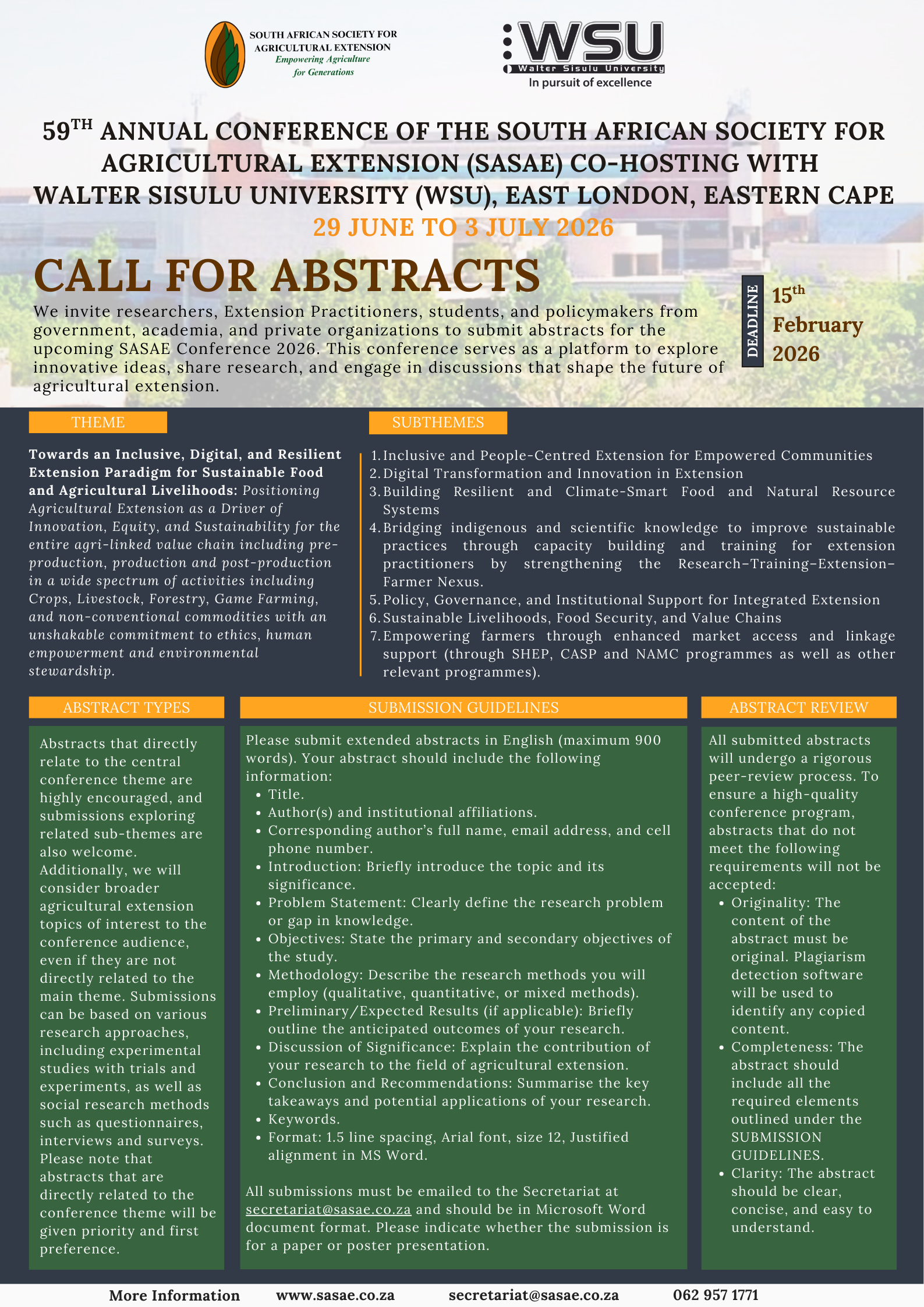
CONFERENCE DATE: 29 JUNE TO 3 JULY 2026
CALL FOR ABSTRACTS
We invite researchers, Extension Practitioners, students, and policymakers from government, academia, and private organizations to submit abstracts for the upcoming SASAE Conference 2026. This conference serves as a platform to explore innovative ideas, share research, and engage in discussions that shape the future of agricultural extension.
Deadline: 15 February 2026
Theme: Towards an Inclusive, Digital, and Resilient Extension Paradigm for Sustainable Food and Agricultural Livelihoods: Positioning Agricultural Extension as a Driver of Innovation, Equity, and Sustainability for the entire agri-linked value chain including pre production, production and post-production in a wide spectrum of activities including Crops, Livestock, Forestry, Game Farming, and non-conventional commodities with an unshakable commitment to ethics, human empowerment and environmental stewardship.
Subthemes
- Inclusive and People-Centred Extension for Empowered Communities
- Digital Transformation and Innovation in Extension
- Building Resilient and Climate-Smart Food and Natural Resource Systems
- Bridging indigenous and scientific knowledge to improve sustainable practices through capacity building and training for extension practitioners by strengthening the Research–Training–Extension Farmer Nexus.
- Policy, Governance, and Institutional Support for Integrated Extension
- Sustainable Livelihoods, Food Security, and Value Chains
- Empowering farmers through enhanced market access and linkage support (through SHEP, CASP and NAMC programmes as well as other relevant programmes).
ABSTRACT TYPES
Abstracts that directly relate to the central conference theme are highly encouraged, and submissions exploring related sub-themes are also welcome. Additionally, we will consider broader agricultural extension topics of interest to the conference audience, even if they are not directly related to the main theme. Submissions can be based on various research approaches, including experimental studies with trials and experiments, as well as social research methods such as questionnaires, interviews and surveys. Please note that abstracts that are directly related to the conference theme will be given priority and first preference.
SUBMISSION GUIDELINES
Please submit extended abstracts in English (maximum 900 words). Your abstract should include the following information:
- Title.
- Author(s) and institutional affiliations. Corresponding author’s full name, email address, and cell phone number.
- Introduction: Briefly introduce the topic and its significance.
- Problem Statement: Clearly define the research problem or gap in knowledge.
- Objectives: State the primary and secondary objectives of the study.
- Methodology: Describe the research methods you will employ (qualitative, quantitative, or mixed methods).
- Preliminary/Expected Results (if applicable): Briefly outline the anticipated outcomes of your research.
- Discussion of Significance: Explain the contribution of your research to the field of agricultural extension.
- Conclusion and Recommendations: Summarise the key takeaways and potential applications of your research.
- Keywords. Format: 1.5 line spacing, Arial font, size 12, Justified alignment in MS Word.
All submissions must be emailed to the Secretariat at secretariat@sasae.co.za and should be in Microsoft Word document format. Please indicate whether the submission is for a paper or poster presentation.
ABSTRACT REVIEW
All submitted abstracts will undergo a rigorous peer-review process. To ensure a high-quality conference program, abstracts that do not meet the following requirements will not be accepted:
- Originality: The content of the abstract must be original. Plagiarism detection software will be used to identify any copied content.
- Completeness: The abstract should include all the required elements outlined under the SUBMISSION GUIDELINES.
- Clarity: The abstract should be clear, concise, and easy to understand.
More Information: www.sasae.co.za or secretariat@sasae.co.za or 062 957 1771


